

Rehberler
How to Choose a Sliding Gate Motor for a Detached House
Ağu
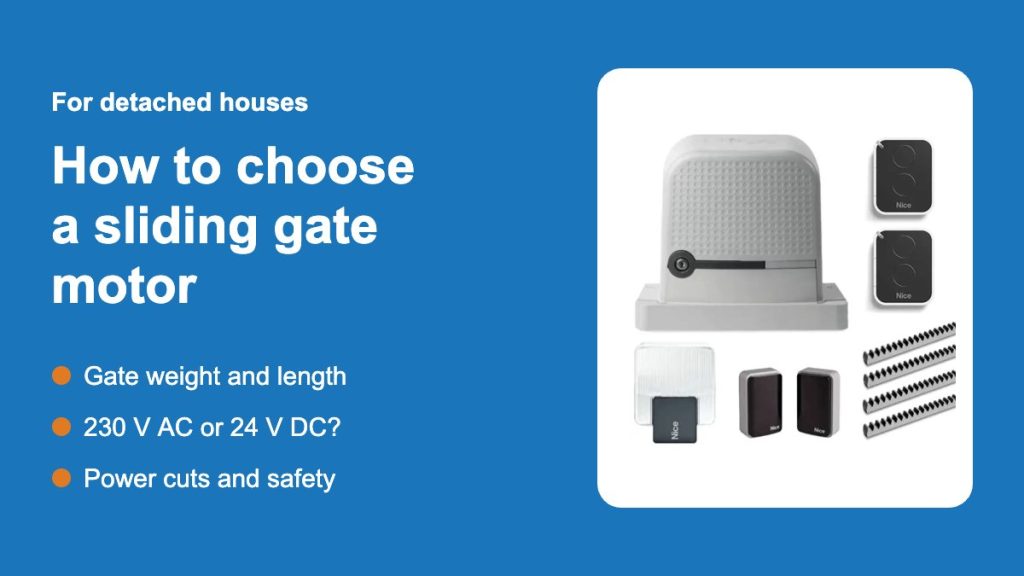
At a detached house, a sliding gate usually opens a few times a day: leaving for work in the morning, coming home in the evening, when guests arrive. So when choosing a motor for a home, two things matter most: how heavy the gate is, and what happens when the power goes out. This guide walks through what to check, step by step.
1. Gate weight and length
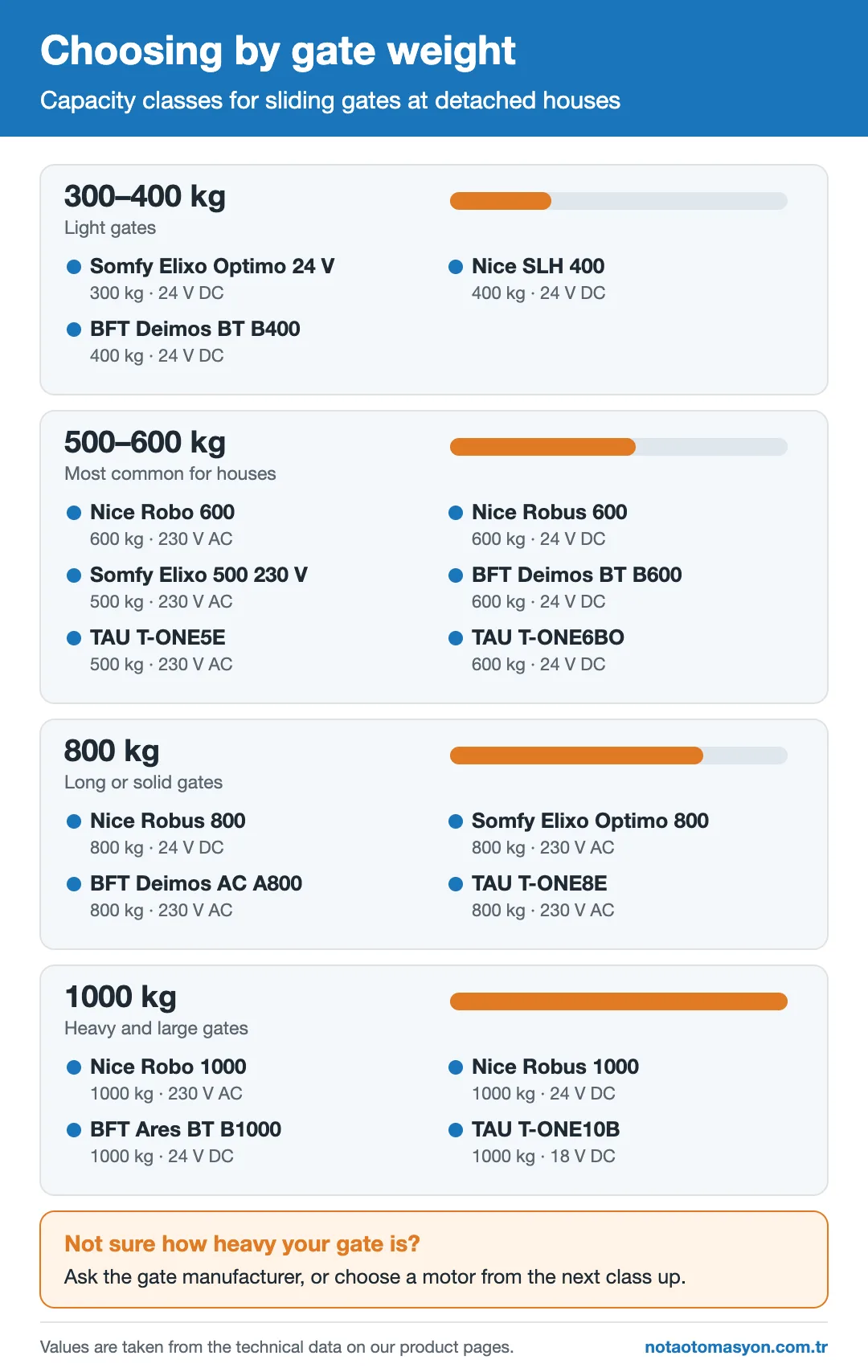
The weight a motor can move is the first thing to check. Pick a motor rated above your gate’s weight rather than close to it; this keeps the motor from straining and helps it last longer. If you don’t know the weight, ask the company that made the gate. If you are unsure, go one class up.
Check the gate length as well. For example, the Nice Robo 600 and Robus 600 suit gates up to 8 metres, and the Robo 1000 and Robus 1000 suit gates up to 12 metres.
2. 230 V AC or 24 V DC?
Sliding gate motors fall into two groups. 230 V AC motors run directly on mains power; they are simple and economical. 24 V DC motors have adjustable speed and a soft start and stop, and most models accept an optional battery.
| Topic | 230 V AC motor | 24 V DC motor |
|---|---|---|
| Example models | Nice Robo 600, Somfy Elixo 500 230 V, TAU T-ONE5E | Nice Robus 600, BFT Deimos BT B600, TAU T-ONE6BO |
| Speed | Fixed | Adjustable, soft start and soft stop |
| Power cut | Gate is opened by hand | Keeps working with an optional battery |
| Frequency of use | House gates opened a few times a day | Gates opened more often |
| Price | More economical | Higher |
For a house gate that opens a few times a day, a 230 V AC motor is usually enough. If power cuts are common where you live, or the gate opens often during the day, a 24 V DC motor is the more comfortable choice.
 Nice Robo 600 Kit600 kg · 8 m · 230 V AC
View product →
 Nice Robus 600 Kit (RBS600)600 kg · 8 m · 24 V DC
View product →
 Somfy Elixo 500 230 V Kit500 kg · 8 m · 230 V AC
View product →
 Somfy Elixo Optimo 24 V Kit300 kg · 6 m · 24 V DC
View product →
BFT and TAU also offer options in the same classes for houses:
 BFT Deimos BT B600 Kit600 kg · 24 V DC
View product →
 TAU T-ONE5E Kit500 kg · 230 V AC
View product →
 TAU T-ONE6BO Kit600 kg · 24 V DC
View product →
 BFT Deimos AC A800 Kit800 kg · 230 V AC
View product →
3. What happens in a power cut?
When the power goes out, a gate with a 230 V AC motor stops working. You open it by hand using the motor’s manual release key. With a 24 V DC motor and a battery, the gate keeps working during the cut. The battery usually isn’t included in the kit and is bought separately; check battery support on the product page of the model you choose.
4. Safety: photocells and flashing light
If there are children, pets or cars at home, photocells are a must. A photocell stops the gate or opens it again when it detects something passing in front of it while closing. A flashing light warns that the gate is moving. Most kits include photocells, a flashing light and remote controls; check the contents on the product page.
5. Is the gate itself ready for a motor?
A motor is designed to push the gate; it does not make up for a gate that slides badly. Before fitting the motor, push the gate by hand: it should slide along the track freely and without catching. If the wheels or track are not right, the motor strains and the gate may stop halfway.
6. Installation
The motor should be connected by following the manual, with the circuit breaker switched off, and the installation needs a tested earth line of the correct value. Seating the rack correctly on the motor gear and setting the limits are the most important steps. If you get stuck, you can contact us during working hours.
In short: which motor should you choose?
- Up to 600 kg, house gate opened a few times a day: Nice Robo 600, Somfy Elixo 500 230 V or TAU T-ONE5E (500 kg).
- Up to 600 kg, frequent power cuts or frequent use: Nice Robus 600, BFT Deimos BT B600 or TAU T-ONE6BO; check battery support on the product page.
- Light and short gates: Somfy Elixo Optimo 24 V (300 kg, 6 m) or BFT Deimos BT B400 (400 kg).
- 800 kg class: Nice Robus 800, BFT Deimos AC A800 or TAU T-ONE8E.
- 1000 kg class: Nice Robo 1000, Nice Robus 1000, BFT Ares BT B1000 or TAU T-ONE10B.
Frequently Asked Questions
What capacity motor do I need for a house?
Choose a motor rated above your gate’s weight. Most house gates work with motors in the 600 kg class, but ask the gate manufacturer for the exact weight before deciding.
How do I open the gate during a power cut?
Use the motor’s manual release key to free the motor and open the gate by hand. If a battery is fitted to a 24 V DC motor, the gate keeps working during the cut.
Is 230 V or 24 V better?
Each has its place. 230 V AC motors are simple and economical, and enough for house gates opened a few times a day. 24 V DC motors offer speed adjustment, soft stop and a battery option.
Can I install the motor myself?
Installation can be done by following the manual, with the circuit breaker off, on a system with a tested earth line of the correct value. If you get stuck, you can contact us during working hours.
The content and images on this site are protected by intellectual property rights and may not be used without permission.
